Bridge Specialty Group connects retail partners with tailored insurance solutions through specialized practice groups spanning Property, Casualty, Environmental, Executive Risk, Farm & Ranch, Healthcare, Life Sciences, Personal Lines, Public Entity, Transportation, and Workers’ Compensation.
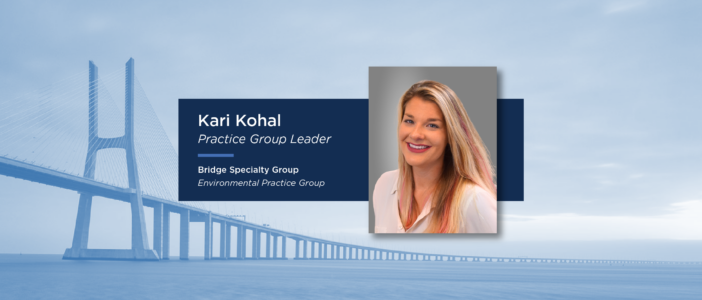
This month’s practice group feature highlights the Environmental Practice Group, led by Kari Kohal, president and managing director at ARMR.
ARMR’s integration into Bridge Specialty Group
The insurance industry thrives on innovation, collaboration and the ability to adapt to emerging risks. Few stories illustrate this better than the integration of American Risk Management Resources Network (ARMR) into Bridge Specialty Group—a move that has not only expanded capabilities related to environmental insurance but also fostered a culture of thought leadership and collaboration. In a recent interview, Kari Kohal, president and managing director at ARMR and Bridge Specialty Group’s Environmental Practice Group leader, shared her perspectives on ARMR’s journey in the environmental insurance space and offered her thoughts on the importance of this specialized coverage and the Environmental practice group’s role in working collaboratively with teammates and retail brokers.
Evolution and future focus of the Environmental Practice Group
ARMR has been working in the environmental insurance space for more than 25 years, operating independently, and their integration into Bridge Specialty Group a little more than a year ago has been transformative. With 35 teammates at ARMR today, the Environmental Practice Group has evolved from its inception into a dynamic, forward-looking team. Kari highlighted the importance of education and internal engagement, noting that increasing environmental insurance market penetration is a strategic goal. Kari highlighted the opportunity in this space when she stated, “Environmental insurance only has a 2% market penetration, which means that 98% of the people who have environmental risk are not purchasing the insurance.” She said that sometimes executives don’t see their environmental risk as pressing on their business. A manufacturer might not consider it important either and doesn’t want to spend the premium. She added, “What we see most often is that insurance consultants or agents aren’t always aware of what constitutes an environmental risk within a business. As a result, they might not discuss issues like pollution exclusions or gaps in coverage with their clients—even though these gaps exist through no fault of their own.” All that to say, if a manufacturer doesn’t purchase environmental insurance, they’re responsible for covering losses out of pocket, which impacts their margins. Some try to rely on property policies, but those often don’t provide coverage, or the coverage is severely sub limited. Increasingly, claims adjusters—especially with the help of AI—are getting better at identifying and enforcing pollution exclusions, leaving more insureds without protection for environmental losses than ever before.
“Educating about these risks is our sweet spot,” according to Kari. “What many don’t know is the definition of a pollutant is any release, escape, dispersal of any irritant or contaminant. It can include vapor; it can include soot. So really when we look at environmental risk, anything in the right quantity going somewhere where it’s not supposed to go is a pollution loss. We’ve seen chocolate syrup being a pollution loss. We’ve seen mac and cheese powder be a big pollution loss. Any event causing natural resource damages or something you must clean up is most likely a pollution loss. Many fire and water restoration contractors were relying on general liability policies that excluded coverage for fungi and bacteria, leaving them unprotected against mold, lead, asbestos and bacteria exposures they face daily. We invested significant effort in educating these clients and designing specialized insurance policies to address those gaps. As a result, our brand is well recognized in the fire and water restoration space.”
Looking ahead, the Environmental practice group sees exciting opportunities on the horizon. “Over the next two, three and five years, our focus will be on education with our retail clients and teammates on deepening their understanding of environmental risk and the technical aspects of the environmental insurance policies. By doing so, we aim to build their confidence and help close the gap in pollution coverage within their programs,” Kari explained.
Market trends and technical insights
Environmental insurance is a complex field, shaped by claims trends, policy customization and the technical aspects of underwriting and risk management. When asked about the makeup of their book, Kari shared, “Our book of business is probably 99.5% non-admitted excess and surplus lines.” She says she and her team enjoy being in the E&S business because they can manuscript policies, allowing for tailored solutions that address specific risks. “For example, I once wrote a policy for the chromium plating on the landing gear made be a major airline manufacturer in Madrid, where a “plume”—a concentrated area of pollution—was present in the soil. In these cases, we track how the earth and water table move to determine the plume’s direction. This allows us to customize E&S market policies, offering coverage for pre-existing chromium, but only within a specific area of the site. We as brokers can say, ‘Hey, we’ll give you pre-existing chromium coverage but only in this quadrant of a location.’ These coverage designs we wouldn’t be able to do with admitted lines.”
Emerging risks and industry focus areas
As the Environmental Practice Group continues to deliver highly customized solutions for complex risks, staying ahead of emerging threats is just as critical. The landscape of environmental insurance is constantly shifting, with new risks emerging every year. And when our conversation with Kari moved to discussing regulations, she quickly spoke of one of the most pressing concerns today, which is per- and polyfluoroalkyl substances or PFAS, a compound found in firefighting foam, food packaging and countless consumer products. Kari explained,
“I think the biggest emerging risk is PFAS because it’s literally everywhere. There’s a lot of media attention around it because they’ve been able to link high exposure to PFAS with certain types of cancer. It’s driving more people businesses to want to manage their environmental risk better, so we are seeing a lot more discussions of insureds concerned about their PFAS exposures and wanting to buy insurance for that.”
Another emerging risk we see in the environmental insurance industry is climate-driven risks. We are seeing more environmental losses due to storms and wildfires. The stronger the storms and the larger the wildfires are, the more likely a property owner or manager will be affected by the release escape dispersal of an irritant or contaminant causing BI, PD, and/or cleanup.”
Beyond tracking industry trends, the Environmental Practice Group serves contractors, developers, healthcare, fire and water restoration, and manufacturing clients, staying ahead of environmental threats through ongoing learning and adaptation.
Importance of strong carrier relationships
Along with the topic of emerging risks comes the topic of carrier relationships. According to Kari, strong relationships with carriers and underwriters are at the core of ARMR’s approach, and it’s something they’ve focused on for 25 years.
“We’ve found value in partnering with carriers, and specifically underwriters who are extremely knowledgeable in environmental risk. Doing that helps us be better brokers. We don’t blanket the market; instead, we engage in meaningful conversations early to ensure we are brokering solutions that are the right fit for the client. We call it resource-backed brokering because we want to be there throughout the entire life cycle of that policy and beyond. We set expectations early and that’s what gives us such a high renewal retention ratio with our agents. We have an 80% new business hit ratio on average, and we keep about an 88% renewal retention every month. And that’s because we’re setting it up for the next five years. We’re not just setting it up to get that one quote.”
Kari added that their policies are varied in length. While many are multi-years, especially those driven by mergers and acquisitions, where they can write policies up to 10 years and $10 million—others are tailored to operational needs. This partnership-driven strategy with carriers not only helps ARMR secure the best coverage but also leads to high client retention and long-term success, setting them apart from competitors who may lack these trusted carrier connections. She added,
“Many risks—like PFAS coverage—are so specialized that only a handful of carriers will even consider writing them. At a Society of Environmental Insurance Professionals conference, someone mentioned that there are only 50 carriers who will even look at environmental insurance. For example, there may be just five carriers willing to insure PFAS exposures, and fewer than 10 truly capable of handling complex environmental risks. Being in the E&S market we do see frequent changes in appetite from our carrier partners, which makes it critical to specialize in the line of coverage, or partner with a wholesaler that does.”
Maintaining ongoing relationships with these carriers isn’t just important to the practice group, it’s the foundation of their ability to deliver tailored solutions and stay ahead in a rapidly evolving market.
The power of practice group synergy and collaboration
One of the hallmarks of Bridge Specialty Group is its collaborative approach. Each of Bridge’s specialized practice groups fosters collaboration, leverages deep expertise and ensures that clients receive the best possible solution for even the most complex risks. This synergy is what sets organizations like Bridge Specialty Group apart in the marketplace.
Kari shared, “The more complex the risk is, the more they’re able to solve those problems. That’s why I think Bridge Specialty Group having practice groups is so important for our retail partners. It helps us deliver a competitive advantage that wholesalers who don’t have practice groups can’t do.”
According to Kari, practice groups’ deep understanding of local risks, combined with hands-on experience, enables them to deliver tailored solutions that generalists may overlook. The groups break down organizational silos and bring together teammates with diverse experience to collaborate on risks that require specialized knowledge and creativity.
In one instance, when faced with an account heavy in casualty risk, the environmental practice group recognized that their casualty colleagues were better equipped to serve the client. Rather than struggle through unfamiliar territory, they transferred the opportunity to the casualty practice group, ensuring the client received expert guidance. This collaborative approach not only benefits our retail clients but also strengthens the Bridge Specialty Group’s reputation for collaborative, high-quality service.
Fostering confidence in a complex insurance landscape
The integration of ARMR and the Environmental Practice Group into Bridge Specialty Group has set a new standard for collaboration, education and innovation in environmental insurance. By sharing expertise, embracing emerging risks, and fostering a culture of continuous learning, the Environmental Practice Group is helping brokers and agents navigate a complex landscape with confidence.
Environmental Practice Group offerings
Strengths
- Global access to 40+ environmental insurance carriers
- Exclusive product offerings and tailored endorsements
- Coverage comparisons, risk assessments and training tools for agents
- Consulting and expert witness services, including work with the EPA and U.S. Army Corps of Engineers
- Active engagement with leading industry groups and education platforms
Coverages
- Environmental impairment liability / Site Pollution
- Products pollution
- Contractors pollution liability (CPL)
- Transportation pollution liability (TPL)
- Non-owned disposal site (NODS)
- Combined forms* (GL, Pollution, Professional)
- Excess liability
- Companion work comp & auto
* Available for select risks
Specialties
- Schools and municipalities
- Assisted living and hospitals
- Manufacturers, warehouses and recyclers
- Brownfield and development projects
- General and trade contractors
- Fire and water restoration contractors
- Environmental consultants and contractors
- Farm and agriculture operations
- Mergers & acquisitions / risk transfer
- Controlled burn contractors and wetland assurance
- Real estate portfolios (lender-placed and REO)
- Energy, renewables and wastewater plants
- Habitational
For more information about the Bridge Specialty Environmental Practice Group, contact [email protected]
This material has been prepared for general informational purposes and is not intended to be applied to any reader’s particular circumstances.
©2026 Copyright Bridge Specialty Group. All Rights Reserved.