Public entity insurance operates in a world of its own — one shaped by tort immunity, political scrutiny and complex exposures that demand specialized carriers and tailored solutions.
Apex Insurance Agency, a nationally recognized brand and member of global wholesale brokerage, Bridge Specialty Group, serves as the platform for the Public Entity Practice Group and thrives in this environment because of one defining strength: collaboration. It’s the glue that connects technical expertise, creative thinking and strong broker relationships to deliver solutions that work in real-world conditions.
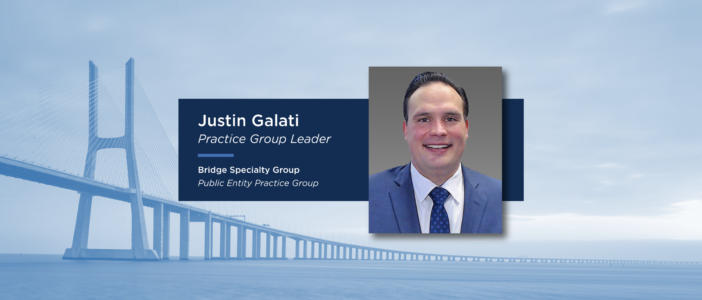
As Practice Group Leader, Justin Galati says, “Public entity is more niche. It’s completely different than general commercial. It’s a different animal.” That perspective gives the group not just market knowledge but also a shared sense of purpose — to problem-solve together, stay informed ahead of emerging risks and serve as true partners to retail brokers nationwide.
How wholesale expertise strengthens Public Entity programs
According to Justin, the wholesale team’s value comes from knowing the players, the markets and how to craft solutions when standard placements don’t fit. “We know how to structure things like corridors, aggregate stop-losses or deductible programs that make sense for both the pools and carriers,” he explains. “It’s about aligning incentives so the program stays actuarially sound—and everyone at the table can move forward with confidence.”
Because the practice operates nationally, Justin says his team can spot patterns early—whether it’s shifting carrier appetites, new wording trends or emerging litigation pressures. “We’re seeing what’s happening in California or New York right when it becomes an issue,” he says, “and that broader visibility helps us advise our retail partners on what to expect and how to prepare.”
“At the end of the day,” Justin adds, “retail brokers are the ones facing clients and bringing local insight. We partner with them to bring specialized expertise, the market access and the creative problem-solving that make those programs stronger and more resilient.”
Where the current public entity market stands
When Justin addressed the current market, he commented specifically that the casualty marketplace has eased slightly since the peak of the post-COVID hard market, but not enough to signal a full return to pre-hard-market conditions. “It’s definitely softened since the hard market from COVID,” Justin explained. “But we’re still seeing rate increases anywhere from three to five percent, upwards of high single digits.”
Geography is the key differentiator. “Every state is different in public entity due to tort immunities,” Justin noted. In places like California, where there’s “really no tort protection whatsoever” and “the most nuclear verdicts of any state in the country,” conditions remain nearly as tight as ever. Meanwhile, states like Colorado are becoming more challenging due to shifts in law enforcement liability and abuse-related exposures.
And across the board, commercial auto continues to weigh heavily—especially for municipalities managing “hot pursuits” and emergency response fleets. With fire, police and other emergency vehicles in the mix, exposure can multiply with every pursuit and every policy clause.
Justin put it bluntly, “Everybody knows auto is challenging. It doesn’t matter what industry you’re in.”
Limited capacity and emerging risks
Even as pricing stabilizes, capacity limits remain restrictive. Justin explained that capacity in public entity casualty has tightened significantly over the last five to six years since COVID began. “Carriers that were offering $15 million cut to $10 million, then to $5 million,” he said. “Pretty much no markets from five to six years ago are offering more than $5 million now, and some are capped at $2.5 million.”
Overall casualty, including GL, SAM, law enforcement and public officials, faces this constraint. “Nobody’s offering more than $5 million except one new player that’s created some real disturbance,” Justin noted. “They can offer $10 million and have been very competitive since opening up about a year and a half ago.”
As mentioned, what happens in high-litigation states such as California and New York often sets a precedent that ripples outward nationally.
And with limits harder to secure and fewer markets willing to stretch, the pressure shifts from how much capacity is available to what exposures are driving carrier caution in the first place.
From an emerging risk perspective, on the group’s current watchlist are two major pressure points: law enforcement liability and sexual abuse and molestation (SAM). “Carriers are watching these with a magnifying glass,” Justin explained. What’s litigated in one state often becomes tomorrow’s test case in another. “And although those specific lines are really more of a carrier position to monitor and keep an eye on, we’ve been able to get crafty to place it when it’s become a problem.”
An additional market trend sees carriers pushing SAM coverage from occurrence to claims-made forms. Most policies are still written on an occurrence basis, exposing carriers to “reviver claims” from the 1980s or 1990s that suddenly hit books decades later. “All of that was written on an occurrence basis that has been closed out for 40 years or more, and now all of a sudden you have a loss on that policy,” Justin noted.
Insureds resist the shift, fearing limited retroactive dates or tail coverage will leave prior years exposed. Carriers counter that they can’t risk closing a policy only to face a $20 million claim 20 years later. “I can relate with insureds and carriers alike, and it’s about finding the middle ground,” Justin said.
The handwriting is on the wall: monoline standalone abuse markets already require claims-made coverage exclusively. “If your abuse coverage gets non-renewed due to claims and you go to the standalone market, you’re going claims-made whether you want to or not,” Justin explained. This mirrors past shifts in public officials and employment practices liability, which have largely moved to claims-made forms.
Collaboration as a competitive edge
Innovation rarely happens in a vacuum. It’s the practice group’s collaborative approach that turns creative ideas into successful placements.
That inventive mindset comes from a culture that invites open discussion and collective troubleshooting. For example, when carriers push retentions higher after loss activity, the group pressure-tests alternative structures that balance carrier comfort with budget feasibility. “It’s actuarially sound for pools and carriers alike,” Justin explained. These ideas often arise through cross-team dialogue, where different perspectives spark better outcomes.
Collaboration also expands the team’s capacity to move quickly. “When you get one broker working on something, you’re actually getting the entire practice group behind them,” Justin said. The group holds quarterly broker calls to discuss new markets, limit adjustments and emerging issues. “When something big is transpiring,” Justin shared, “someone shoots out an email and copies a handful of us to get eyes on it right away. It’s our collaboration — our combined knowledge.” This isn’t just internal teamwork; it’s an integrated network that stretches across retail and carrier relationships, giving the practice group powerful insight into what’s changing — and where new opportunities might lie.
That team-based approach leads to measurable results. In one recent example, the practice group partnered with a retail agent who had inherited a large excess liability purchasing group. Capacity issues were stalling growth, as markets involved in the underlying pool layers blocked new entrants from the excess tower. Justin and his team restructured the program to “bypass certain layers,” adding carriers with no primary stake and building “a whole separate tower.” The outcome: more capacity, happier members, and a stronger program foundation.
Teamwork in action translates into tangible value
For retail brokers, that collaborative foundation translates into tangible value. “We look at this as a partnership,” Justin said. “Our team becomes their marketing and back-end legwork team.” That partnership ensures clients get not only access to the right markets but also a team of specialists focused on structure, wording and carrier strategy — all informed by national reach and real-time intelligence.
Scale adds weight, too. “We’re the largest source of production for at least five of the largest markets in public entity,” Justin noted. When leverage or creativity is needed, that reputation helps move the conversation. But underneath it all is a people-first mindset and a commitment to help brokers move from a roadblock to a path forward, even when the first answer from the market is no.
Building on experience. Expanding on success.
Looking ahead, Justin Galati sees the Public Entity Practice Group’s future as an expansion of what it already does well—not a reinvention. He sees the team doing the same core work and showing up as the public entity experts in the space, while becoming better known and easier to engage from the big brokers’ perspective. Justin expects the path forward to be shaped by the same forces already compressing the market—tight capacity, tougher underwriting and evolving litigation and liability trends. But Justin’s focus is less on simply navigating what’s next and more on continuing to help brokers and pools win in it: pairing national market intelligence with a collaborative bench of specialists who can move quickly, negotiate confidently and structure programs that hold up under scrutiny.
As the space grows more complex, that combination of end-to-end support, creative structuring and a partner-first approach grounded in real teamwork, will be what keeps difficult placements moving and long-term relationships strong. For the group, the future isn’t just growth; it’s earning the right to be the first call when the placement is challenging and the stakes are high.
Public Entity Practice Group offerings
Coverages
- Property & Casualty
- Package Property & Casualty
- Workers’ Compensation
- Excess and Reinsurance
- Cyber
- Pollution Liability
- Active Shooter, Conceal Carry
- Professional Liability
- Student Accident & Volunteer Accident
- Crime & Fiduciary Liability
- Monoline EPL & Sexual Abuse
- Special Event Services
Strengths
- Public Entity Brokerage services place over $700M in premium across multitude of market partners
- Full-Service Brokerage/Underwriting/Loss Control/TPA/Administrative operations provide solutions for over 100 pools and trusts across the country
- Access to First Dollar Deductible/SIR/Excess High Limits for single risk, pools and purchase groups
- Capability to move pool structures from in-house staff to third party providers
- Providing administrative services to move from traditional deductible to attainable SIR with TPA and controls in place
- Offering comprehensive, cost-effective insurance program packages and Monoline Professional Liability
- Deliver broad range of data driven Loss Control services
- Excess Workers’ Compensation
- Buffer Workers’ Compensation / SIR Buy Down
Programs
- K-12 Public, Private, Charter
- Schools, Colleges and Universities
- Tribal / Sovereign Nations
- Special Districts, Water, Sewer, Sanitary
- Non-profit and Social Services
- Municipalities
- Law Enforcement Agencies
- Housing/Transit/Airport/Water Authorities
- Special Purpose Government Entities
- Educational Systems
- Tribal / Sovereign Nations
This material has been prepared for general informational purposes and is not intended to be applied to any reader’s particular circumstances.
©2026 Copyright Bridge Specialty Group. All Rights Reserved.